Quick Take The Manhattan market kicked off 2026 on steadier ground than a lot of people expected. Demand picked up a bit, inventory tightened, and pricing held steady overall.
For those of us with property in the Garment District or Midtown South, the real question is whether these early shifts are the first signs of the rezoning taking hold or if it is still too soon to call it.
Q1 2026 Manhattan Market: The Key Data. Here is what stood out in the first quarter:
- Inventory dropped below 5,000 units, the lowest it has been in about a decade.
- Contract activity increased year-over-year, showing stronger buyer interest.
- Median days on market came down to around 75 days, roughly 8 to 9 percent faster than the same time last year.
- Price per square foot stayed essentially flat at about $1,370.
- Median sale price rose modestly, around 4 percent year-over-year, but that was mostly due to the mix of deals, not broad price appreciation.
What This Actually Means: This is not some big price surge. It is more like the market is stabilizing with better underlying fundamentals.
Buyers are out there and active, but they are still being selective. Sellers are getting a little more leverage, but only if the price is realistic. Overall, pricing is holding firm rather than taking off. That difference matters a lot right now.
Supply Is the Real Story: The biggest shift I saw in Q1 was not on the pricing side. It was the compression in inventory. When supply drops and demand improves even modestly, a few things tend to happen:
- Competition picks up for the well-positioned listings.
- Apartments that are priced right tend to move faster.
- The market gets more efficient, with less room for big pricing mistakes.
We are starting to see that dynamic play out more clearly.
A Market Moving at Two Speeds: One thing that jumped out from the Q1 numbers is how uneven things feel depending on the unit. Not every apartment is selling the same way.
- Well-priced, turnkey units are often going into contract in 30 to 60 days.
- Overpriced places or ones with awkward layouts are sitting longer and usually need price cuts, often in the 5 to 10 percent range.
This is what an efficient market looks like. Buyers are deciding quickly, but only when the value is obvious.
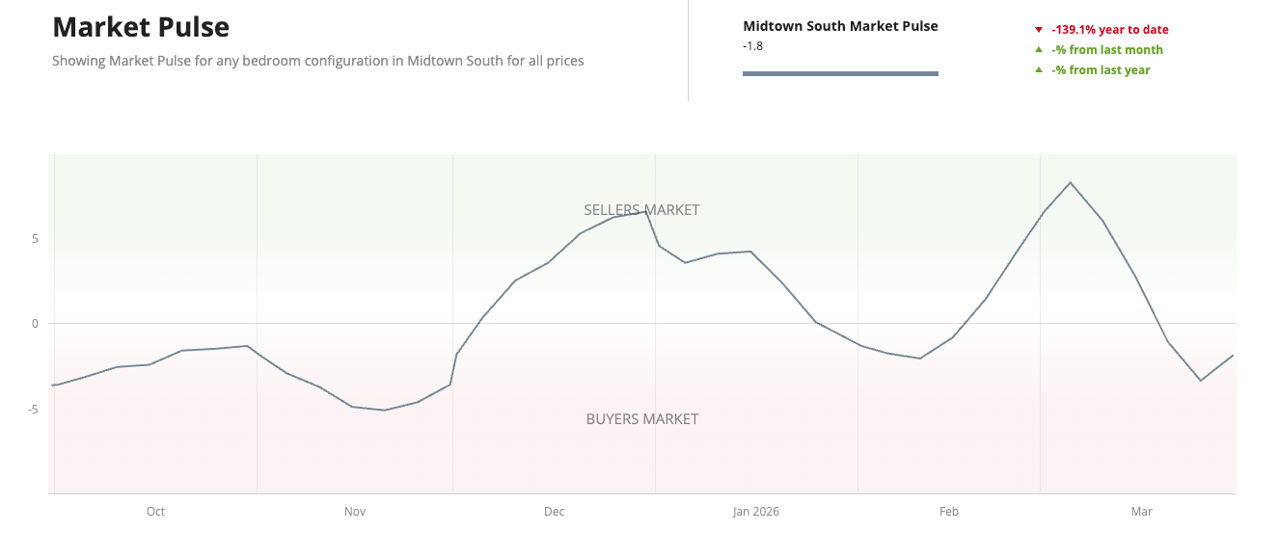
What We Are Seeing in Midtown South: While a lot of the data gets reported at the full Manhattan level, there are some interesting early signals coming out of Midtown South specifically:
Retail activity is picking up, vacancy rates are trending down, and we are seeing more residential-supporting businesses moving in.
For example, recent numbers show retail vacancy in the area down roughly 19 percent over the past two years, with restaurant and service businesses growing faster than the Manhattan average.
That might not sound flashy, but it matters. As the neighborhood shifts toward more mixed-use, better street-level life makes the area more appealing for actual residents, which ultimately supports residential demand and values.
Are Buyers Pricing in the Rezoning Yet?: Short answer: Not fully, at least not in the numbers yet.
Here is why it still feels early. Most of the new residential supply from the rezoning has not been delivered. Comparable sales have not reset higher across the board, and the neighborhood identity is still evolving from its commercial roots.
That said, there are some subtle positive signals:
- Buyers seem more open to Midtown South than they were even 2 to 3 years ago.
- Demand feels a little broader, not just the old loft crowd.
- Overall confidence in the area long-term path is clearly improving.
This lines up with the early stages of a rezoning cycle. Perception starts shifting before the big pricing moves show up in the data. Remember, the Midtown South Mixed-Use Plan was approved back in August 2025, so we are still in the very beginning of that transition.
What This Means for Owners Right Now: If you own in the Garment District or broader Midtown South:
- The market feels more stable than it did a year ago.
- Buyer demand is there, but it is disciplined. No one is throwing money around.
- Pricing needs to be precise, not hopeful.
Most importantly, we are operating in a transitional market right now. Not at a peak, not in a trough, just somewhere in between.
A Strategic Take: Looking at the Q1 data, Manhattan, and Midtown South in particular, seems to be heading toward a more balanced environment. Not overheated, not weak, but increasingly efficient.
For owners, that means there is real demand in the market today, even as the full effects of the rezoning are still ahead of us.
Final Thought: The Midtown South rezoning is very much a long-term story. Q1 2026 does not show its full impact in the pricing data yet, but it does show improving conditions that often come before bigger changes.
Inventory is tight. Demand is steady. The neighborhood is slowly evolving.
That combination is worth watching closely.
If you are curious how your apartment stacks up against the current market or what the rezoning trajectory could mean down the line, feel free to reach out. I am happy to walk through the latest comps and give you some honest context. No pressure, just useful perspective.